Coverstar! Who Me?!
New Zealand Herald: Stephen K Amos @ The New Zealand International Comedy Festival 2026
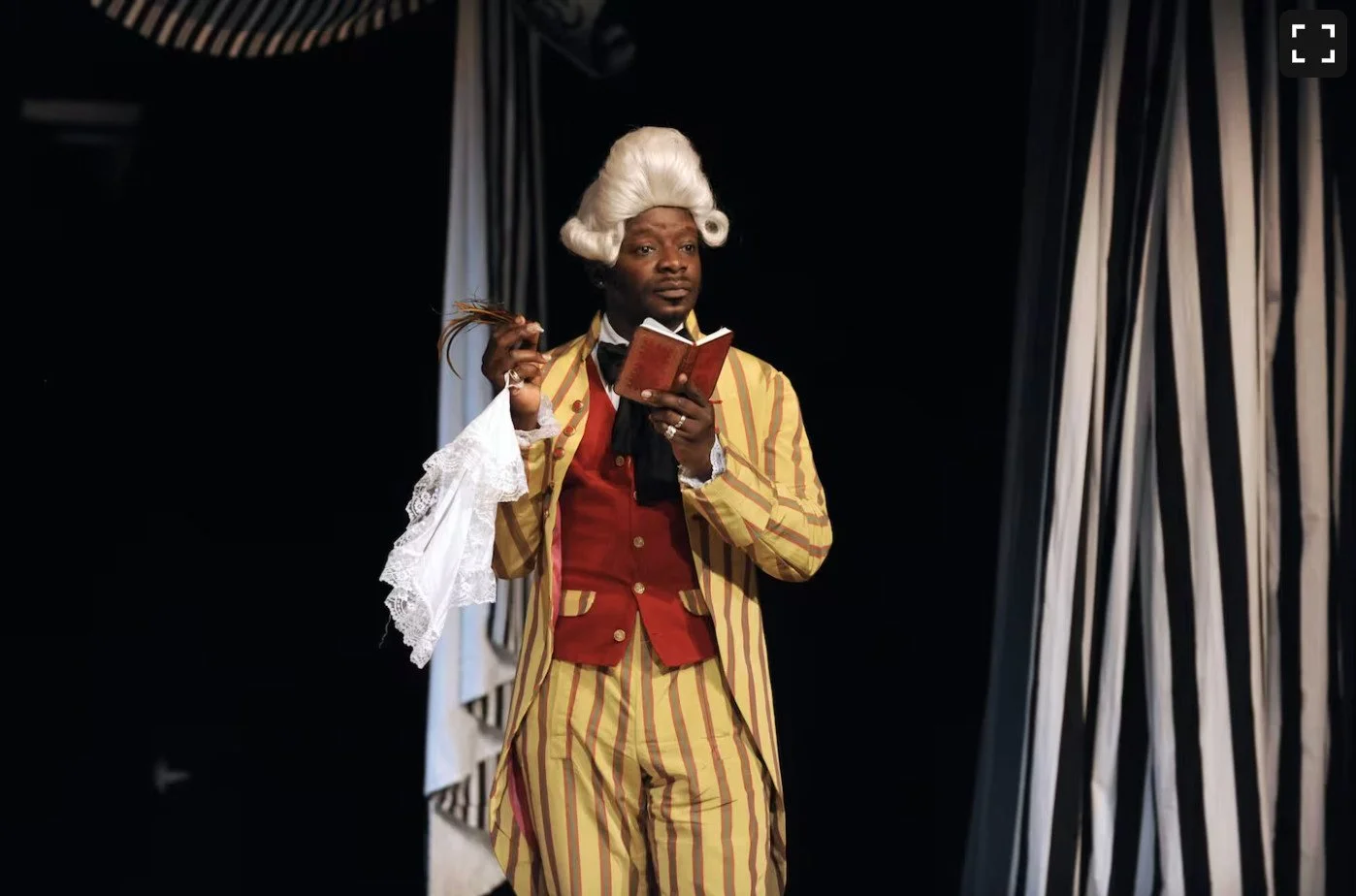
Now We’re Talking: Stephen K Amos show hits NZ Comedy Festival
He’s no shock jock, but don’t try telling British comedian Stephen K Amos what he can or can’t say.
No one knew quite what to make of Stephen K Amos when he first emerged on the London stand-up scene, this black comedian with his snappy clothes and British accent.
When his parents migrated from Nigeria in the 60s and were looking for a place to rent, there’d be signs saying, “No Irish, no blacks, no dogs”. Amos used to joke about that in his show.
“When I started in my comedy career, I was always wearing suits and looking quite dapper and sounding like, what … James Bond?” he says. “Everyone was like, ‘What the hell’s going on here?’ No one on television looked or sounded like me.”
People were thrown off again (some of them, anyway) when Amos came out as gay in 2006 at the Edinburgh Festival Fringe in his solo show All of Me.
Not that his sexuality had been a secret, but it wasn’t something he’d platformed, either, until a young man he knew was killed in a targeted homophobic attack on Clapham Common. Two men were sent to jail for his murder.
The following year, his documentary on homophobia in the black British community and Jamaica, Batty Man, won a Royal Television Society Award and was nominated for a Bafta.
Australia was still debating same-sex marriage, already legalised in New Zealand, when Amos toured there in 2017. That made it into his set, too.
“Even South Africa has gay marriage,” he told the crowd. “And they’re marginally more racist than you!”
A decade ago, his touchstones were Brexit, the first Donald Trump presidency, a worldwide financial crisis and a backlash against immigration. It’s disconcerting to consider how little the landscape has changed.
These days, however, he’s less overtly political – the kind of feel-good performer whose stories come with a twitch of the lips and a wink to the audience so everyone’s in on the joke.
Take his classic gag about bowing to the Queen at a post-show meet-and-greet, for example: “I was this close to licking the back of her head and putting it on an envelope.”
The ground literally shook the last time Amos performed in New Zealand. In 2016, he was on stage in Wellington when an earthquake struck. The audience didn’t flinch.
After a long absence from Aotearoa, the 58-year-old will be doing some homework before he flies in from Sydney with his new show, Now We’re Talking, which opens at the NZ International Comedy Festival next week.
“One of the first things I’ll do is look at the news to see what’s happening and maybe weave some of that in, so I can come with an outsider’s perspective and point out things you might not have noticed that I find funny,” he says.
This time, Trump won’t get a look in. “I want people to come to my show who don’t necessarily think like me, who have different backgrounds in terms of race, education, religion, economics and age.
“I want my comedy to transcend all those barriers, so I make a conscious effort not to talk about Trump saying this or that. I mean, we’ve all heard it, we all know it. The war in the Middle East … People have come to watch a comedy show. They’ve not come to watch a man ranting about the cost of fuel.”
An evocation of his 70s childhood, before the shoutiness of social media, Now We’re Talking celebrates laughter’s ability to unite people and help us cope during times of stress and anxiety.
Amos, who’s done a deep dive into the science of this, reckons the ability to laugh – and make others laugh on purpose – is a distinctly human phenomenon.
“Babies learn to laugh before they can speak,” he says. “It’s how we interact with other human beings who don’t necessarily share the same language or culture as we do.
“It’s something inside us that connects us all. And let’s try not to forget that, because we live in a world where there is a lot of noise. A lot of talking and not enough listening.”
Between tours, Amos lives in Wimbledon, a posh suburb in Southeast London, and is a regular guest on TV shows such as QI, Live at the Apollo and Have I Got News for You.
In July, he has a short-form podcast coming out called Me, I Blame the Parents, talking with six other comedians whose parents migrated to the UK as young adults. Among them is Baroness Ayesha Hazarika, a political commentator and former Labour Party advisor from Scotland whose Muslim parents emigrated from India.
Amos was 13 when he first went to Nigeria and was a regular visitor until borders closed during the Covid pandemic. As a child, meeting his parents’ families and being surrounded by people who looked like him was overwhelming. “It blew my mind,” he says. “There was this unconditional, unspoken love and embracement.
“But then, once that first wave of euphoria disappears, you suddenly realise you don’t speak the language, your mannerisms are completely different, you can’t stand the heat. You don’t quite fit in there, either.”
The title of his 2012 memoir, I Used to Say My Mother Was Shirley Bassey, is a reference to the legendary Welsh singer, whose father was Nigerian. At primary school in South London, Amos was the only black kid in his class, and she was massively popular at the time.
By his teens, he’d become less self-conscious about standing out. “I distinctly remember wearing shoulder pads, stonewashed jeans and massive hooped earrings,” he says, with a laugh.
“I thought I looked amazing! Every Saturday night, we used to go to a nightclub in Vauxhall called Dance Wicked. Those same people are still my friends to this day.”
It sounds like another one of his gags, but Amos really did study criminal justice at polytech before giving stand-up a go. His parents, loving but overprotective, saw education as a form of armour for their children in a world that hadn’t always welcomed them.
“They can take away your accommodation, they can take away your job, they can take away your spirit,” Amos remembers them telling him. “But if you’ve got a degree, nobody can take that away from you.”
He finished his degree, but the office job didn’t stick. In 2001, he made his debut at the Edinburgh Festival Fringe and by the end of that decade, he had his own TV show.
Through his sideline as an actor, he’s portrayed everyone from Jimi Hendrix and Nelson Mandela to the Soul Train conductor in Beetlejuice Beetlejuice and the drunken Cockney dustman Alfred Doolittle in My Fair Lady.
A small but memorable highlight was playing one of Nurse Ratched’s orderlies in an acclaimed 2004 production of One Flew Over the Cuckoo’s Nest on the West End. “I got to beat up Christian Slater every night,” he says, of the US film star cast in the lead role.
Comedy is constantly evolving, says Amos, who’s doing a play at the Edinburgh Festival Fringe this year called Eleven and a Half Angry Men.
In 2007, he hosted a documentary called Penis Envy, with the help of actors from Puppetry of the Penis, naked rugby players and men willing to experiment with penis-enlarging treatments.
He doesn’t think that would fly now. Still, he rubbishes the idea that modern sensitivities have diluted a comedian’s sting.
“The people who used to be the butt of the jokes are now the people telling the jokes,” he says. “The playing field is levelling out and not everyone likes that, you see.
“I hear all the time that the world is too woke, that no one can take a joke anymore. No, no. You can absolutely say what you want. The difference is your motivation. You want to do a racist, homophobic joke? By all means. Do it and see what happens. But why would you want to do that?”
Amos has spoken a lot about the scourge of social media, which he avoids like the plague, and the rise of misinformation in a “post-truth” world. Interestingly, his main takeaway from watching Louis Theroux’s documentary Inside the Manosphere was not toxic masculinity but the greed it exposed.
“One of the people he talked to was saying, ‘I don’t necessarily believe all that stuff, I just write it cos it gets me clicks.’ It’s all money generated. That seems to be the motivation.
“I’m really thankful that I didn’t grow up in an era of social media. People can say the most outrageous things online and it gets them popularity. It gets them followers, whether they mean what they’re saying or not.
“Yes, it’s great to talk, but it’s also very important to listen to each other more. We live in an era where honesty seems to be going out of fashion. Oh, it’s a scary world.”
Of course, cruelty predates social media and Amos knows from personal experience how devastating and undermining that can be.
There’s an anecdote he tells, drawn from his early years as a comedian, about walking down the street and something happened. He won’t go into details here, but it knocked him for six, both physically and emotionally.
Last month, he was contacted by a woman who’d seen his show in Melbourne and was so deeply affected by the vulnerability he showed that she sat in the audience with tears streaming down her face.
“It was lovely because, in a sense, that’s exactly what I’m trying to do with this show, really hit people’s core and let them take away whatever resonates with them,” he says.
“There’s a bit where it sounds like a battle cry – a call to arms, if you will – where I talk about things that are said about so many people online that are not just wrong but wicked and hurtful.
“How do we respond to that? Do we become the strong, silent type and say nothing, or do we vocalise it and clap back? Those are the times when your mental health begins to suffer.”
Stephen K Amos is in Wellington on May 8 and Auckland on May 9 and 10 with his new show, Now We’re Talking, as part of the NZ International Comedy Festival.